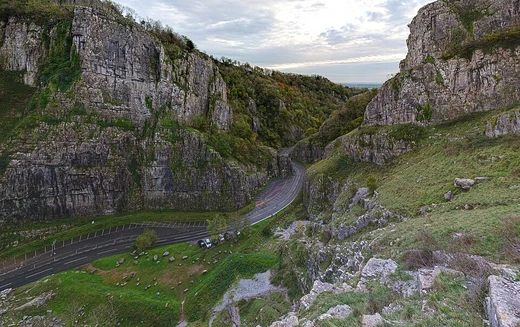
Jewel Cave National Monument
First national monument for cave protection, fifth-longest cave globally.

- location
- Black Hills, South Dakota, approximately 13 miles west of Custer
- known_for
- First national monument for cave protection; breathing cave; calcite crystals
Lore & Background
After enlarging the entrance with dynamite, they found a cavern lined with calcite crystals and named it Jewel Cave. They built walkways and opened it to tourists, but their venture failed, and they sold their claim back to the government.
Reader's Guide
Jewel Cave National Monument holds significance as the first U.S. national monument established specifically to protect a cave, setting a precedent for cave conservation. Its status as a breathing cave—where air movement is driven by atmospheric pressure changes—provides a natural laboratory for studying cave ventilation and hydrology. The cave's calcite crystals, known as 'jewels,' and rare formations like hydromagnesite balloons add geological importance. Ongoing exploration, with only a small fraction of the cave's estimated volume mapped, underscores its role as a frontier for scientific discovery. The National Park Service offers four tours, including a wild caving tour requiring squeezing through a 9-inch passage, and surface trails that pass the historic entrance. The monument's mission emphasizes preserving and interpreting the cave system for scientific and public interest, inspiring continued exploration and education.
Did You Know?
- The cave is named for the calcite crystals that cover many of its walls.
- The cave is a breathing cave, where changes in outside air pressure cause air to flow into and out of the cave.
The Story of Three Discoveries
Three separate moments of chance and curiosity brought the cave system to light over more than three decades. Tragically, knowledge of that entrance faded—whether through a landslide or the deliberate secrecy of the young finders, the cave vanished from public memory for years. That very night, shaken by the vandalism Hansen Cave had already suffered, the group pledged to protect the new find. At seventy-four, Martin himself was the first to step inside what is now Middle Cave.
Ancient Stone, Living Formations
The initial cavity was carved by a network of faults branching off the great Wasatch Fault, and over geologic time, hydrothermal water action—possibly analogous to the processes at Cave of the Winds in Colorado—along with the slow uplift of the Wasatch Range, sculpted the passages visitors walk today. As the cave system was gradually raised above the unnamed stream threading the canyon, mineral-rich water began depositing calcite and aragonite in ever more intricate shapes. Among the most striking are the helictites: hollow, twisted, spiraling straws that defy gravity, created when water threads through a tiny tube and evaporates, leaving a trace mineral residue at the tip. Other formations include cave bacon, columns, flowstone, popcorn, drapery, stalactites, and stalagmites, all visible in a chamber that holds a constant 46 degrees Fahrenheit.
Guardians of the Deep
Preservation was a founding principle from the moment the caves gained protection. Forest Service handled initial development and upkeep. The NPS has since pursued a careful balance between public access and ecological integrity: cave lighting is deliberately limited to slow the growth of invasive organisms, and each guided tour carries a capped number of visitors to reduce human impact. The resource management team continuously monitors conditions inside and around the caves.
Walking the Canyon to the Cave
Reaching the cave entrance is itself a small adventure. Because the path is wide and smooth, it remains accessible to most visitors despite the significant elevation gain. The monument typically opens from May through September, with exact dates shifting based on snowpack and available funding. All cave viewing happens on guided tours, and two options exist: the standard route threading through the full cave system, and an Introduction to Caving experience that teaches Leave No Trace principles for underground environments and ventures deeper into Hansen Cave. The constant 46-degree air and the kaleidoscope of speleothems make the descent feel like stepping into a different geological era.
More in Caves & Gorges 1-23
Spotted an error? Know more?
This is a living reference — every entry is fact-audited, and reader corrections feed straight into our audit queue. Suggest an edit · See this site's audit record