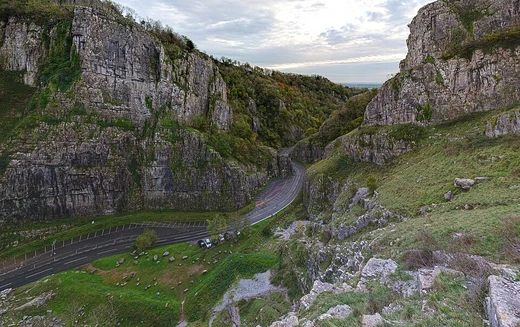
Jenolan Caves

- location
- Jenolan, Oberon Council, New South Wales, Australia
- length
- More than 40 kilometers of multi-level passages
- show_caves
- Eleven illuminated show caves
Lore & Background
The Jenolan Caves have been part of Indigenous culture for thousands of years, holding significance to the Gundungurra and Wiradjuri peoples, who knew it as Binomil or Bin-oo-mur. A Dreamtime creation story of the Gundungurra people describes a struggle between two ancestral creator spirits—Gurangatch, a giant eel-like creature, and Mirrigan, a large native cat or quoll. The Gundungurra people penetrated the caves as far as the subterranean water, carrying sick people to be bathed in this water, which they believed had curative powers.
Reader's Guide
The Jenolan Caves are significant as the oldest known and dated open cave system in the world, with an age determined by measuring the ratio of radioactive potassium and trapped argon gas in clay. The caves contain numerous Silurian marine fossils and noted calcite formations. The cave network follows a subterranean section of the Jenolan River and is still being explored. Tourism has been a key activity since the 19th century, with eleven show caves open to paying visitors.
Did You Know?
- The word 'Jenolan' is believed to be an indigenous word for 'high place', derived from the Tharawal word Genowlan.
- The Orient Cave became the first in the world to be cleaned, in 1968, due to contamination from a coal boiler.
Discovery and the Speleologists Who Found It
The Chauvet-Pont-d'Arc Cave was not stumbled upon by accident. Chauvet, for whom the site is named, later published a meticulous personal narrative of the expedition. On a subsequent visit, another member of the group, Michel Chabaud, accompanied by two companions, pushed deeper into the system and uncovered the Gallery of the Lions and the End Chamber, where the most remarkable paintings reside. The significance of what they found was recognized swiftly: in June 2014, UNESCO elevated the site to World Heritage status, cementing its place among the most important prehistoric art locations on Earth.
An Unusual Menagerie and Unconventional Techniques
Most Paleolithic cave art is dominated by herbivores — horses, aurochs, mammoths. Chauvet breaks that pattern. Researchers have catalogued hundreds of animal images spanning at least thirteen species, and a striking proportion are predators: cave lions, leopards, bears, and cave hyenas share the walls with rhinoceroses. Complete human figures are absent, yet two partial "Venus" images survive, each showing a vulva joined to an unfinished pair of legs. One of these sits beside a bison head, a pairing some scholars have likened to a Minotaur. Red-ochre hand stencils, abstract lines and dots, and two enigmatic butterfly- or bird-shaped forms round out the repertoire, leading several researchers to propose a ritual or shamanic dimension to the decoration. The technical execution is equally unusual. Before painting, the artists scraped the walls free of debris and mineral deposits to create a smooth, lighter canvas. Around certain outlines they incised or etched the rock, lending a three-dimensional relief and an impression of motion. Perhaps most remarkably, the cave contains "scenes" — a pair of woolly rhinoceroses locked in a horn-butting contest — and one drawing, later overlaid with a deer sketch, resembles a volcano belching lava, potentially the earliest known depiction of a volcanic eruption.
The Dating Debate
Pinpointing the age of the Chauvet paintings has been far from straightforward. French archaeologist Jean Clottes, who has led much of the post-discovery research, relied on radiocarbon dating of carbon black extracted from the drawings themselves, from torch scorch marks, and from the cave floor. Yet the chronology has not gone unchallenged. Christian Züchner, working from stylistic parallels with other dated sites, argued the red paintings belong to the Gravettian and the black ones to the Early Magdalenian. Pettitt and Bahn raised further doubts, questioning whether the charcoal source and possible surface contamination might skew the results.
A Sealed Time Capsule: Preservation and Non-Human Traces
The cave's position above the former channel of the Ardèche, in the gorges of southeastern France, placed it in a region already known for geologically and archaeologically significant cavities. What makes Chauvet extraordinary is the degree to which it escaped alteration. After the last human visitors — whose traces include a child's footprints, charred hearth remains, and soot from torches — a landslide sealed the original entrance. The soft, clay-like floor still holds the paw prints of cave bears and large rounded depressions interpreted as the animals' sleeping "nests." Fossilised bones are plentiful, including cave-bear skulls and the horned skull of an ibex. The child's footprints, if confirmed by dating, may represent the oldest human footprints that can be reliably dated, offering a rare, intimate glimpse of an individual who walked these chambers tens of millennia ago.
More in Caves & Gorges 1-23
Spotted an error? Know more?
This is a living reference — every entry is fact-audited, and reader corrections feed straight into our audit queue. Suggest an edit · See this site's audit record